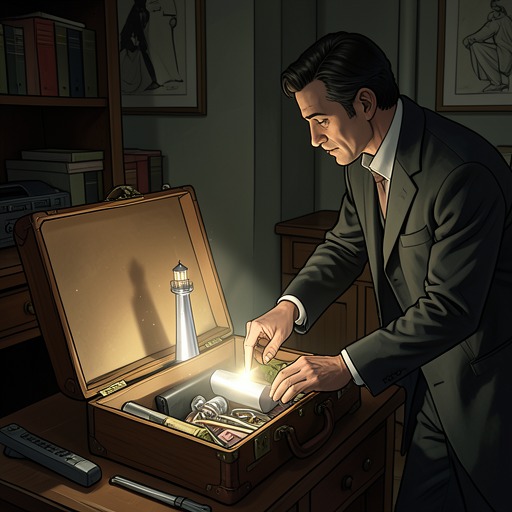
Silver lighthouse perfume case
The Lighthouse (Alison Moore Edition)The Silver lighthouse perfume case is both a container for violet perfume and a portable record of Futh’s fractured family history. Passed through several hands, carried away from its intended return to Ernst, and eventually found among Ester’s possessions, it joins intimate memories to acts of concealment and mistaken or contested ownership. Its glass vial breaks on a family holiday in Cornwall, England; the silver case survives, and its later reappearance gives the damaged object a new role in Futh’s uneasy search for what has gone missing.
Form and Inheritance
The case is an exquisite silver lighthouse containing a stoppered glass vial. Its lighthouse shape makes the object distinctive, but it is also practical: it holds a perfume that can be applied, carried, and recognized by smell. The case enters Futh’s family story through his grandfather, who says it had belonged to his own mother. He instructs Futh’s father to return it to Ernst. Instead, after the visit, Futh’s father gives it to Futh’s mother, who admires the case and the vial, approves the scent, and applies the perfume to her wrists and throat. In the car, still near the house, the smell of violets fills the space. The handover thus diverts the case from its stated destination and brings it into the daily intimacy of Futh’s parents’ marriage.
That transfer also makes the case more than an heirloom with a clear chain of custody. It is given with an instruction to return it, but it comes to be used by Futh’s mother, who calls it Uncle Ernst’s perfume as if she is merely keeping it safe for him. The explanation does not prevent her from wearing it often. The object’s history consequently holds together two different claims: a named obligation to return it and the personal use that makes its scent part of Futh’s memories of his mother.
The Case in Futh’s Childhood
The perfume’s violet scent becomes entangled with Futh’s experience of his mother’s presence and departure. On the night she leaves, he wakes to find her above him in the moonlight; after she goes, he remains alone in the dark with the smell of violets and the sound of her footsteps descending the stairs. By breakfast she is gone. The case is not identified as the source of the scent in that scene, but the later link between his mother’s perfume and violets gives the remembered smell a material counterpart. Its fragrance can summon closeness; it cannot make that closeness last.
Futh’s attachment to the scent is also set against a more complicated inventory of what he remembers as his mother. He used to hide in her wardrobe, among shoes and woollen hemlines, with leather, secret cigarette smoke, and summer camphor from mothballs around him. He would have liked to bottle that layered smell as “Essence of Mother,” but instead he has violets and oranges. The silver case therefore carries one powerful part of his memory without containing the whole of it: perfume offers a recognizable trace, while the private smells of the wardrobe remain irreducible to the object.
During the Cornwall holiday, Futh takes the case from his mother’s handbag and walks away with it. He removes the vial but leaves its stopper in place; he wants to smell his mother’s scent without actually opening it. The gesture makes the case a private means of keeping her near, even as he moves out of earshot of his father’s voice. The perfume remains contained, a closeness he can hold but does not release.
Breakage and Olfactory Memory
The case’s most consequential change occurs on the cliffs. After his mother says she is going home, Futh sees a deep cut in his palm: the glass vial has broken, and perfume stings in the wound, spilled on the grass and his hiking boots. His mother’s departure and the destruction of the vial coincide in one physical image. The perfume is no longer safely enclosed or available for controlled use; it reaches Futh through pain and through the smell left on his belongings.
On the train home, the case, still containing the broken vial, is in Futh’s pocket. His mother does not ask him to return it. The journey preserves an exact contrast of smells: Futh’s unwashed hands and boots strongly of violets, his mother of the orange she has eaten. Years later, when he works in the manufacture of artificial odours, the smell of octyl acetate makes him sad. The remembered orange and the later artificial odor are not the perfume in the silver case, but they show how scents in the novel can become routes back to loss rather than simple descriptions of a person or place.
The case’s damaged condition gives it a double character. The silver container remains intact enough to be carried and passed on, while its original glass contents have been broken. It can preserve the shape and appearance of a valued possession after the means of using it has failed. That material split echoes the gap between Futh’s wish to retain his mother’s scent and the irreversible fact of her leaving.
Ester’s Wooden and Silver Lighthouses
Much later, the lighthouse form reappears in Ester’s dressing room beside a second, smaller object. The morning after her wedding, Bernard gives her a wooden lighthouse case containing Dralle’s Illusion, a vintage perfume she had asked for. The perfume had been advertised as the most costly sold in America, and Ester is disappointed to receive the wooden version: there had been a silver case as well as the smaller, cheaper wooden one. The two lighthouse containers thus mark unequal versions of the same collectible design, and Ester’s disappointment attaches status and expectation to the difference in material.
The silver case beside it is missing its bottle. Ester applies violet perfume, then places her vial inside the silver lighthouse and returns the empty wooden case to a drawer. She hopes that Mr Futh will not notice his missing item. If he does, she plans to blame the people who transported the luggage, expecting that he will have left before an answer is available. Her handling of the cases reverses their apparent roles: the wooden one, which was her wedding gift, is put away empty, while the silver one becomes the container for the perfume she has just used. The transfer is concealed rather than explained, and the reader sees the practical detail of her plan as well as her expectation that Futh will soon be gone.
Recognition in the Hotel Room
When Futh later hides in Ester’s bathroom, he watches her put the silver lighthouse away in a drawer. He hears her smoke, and the cigarette smoke reaches him through the open windows. A separate smell then redirects his attention inward: after knocking against bottles by the bath, he opens one and smells camphor, which carries him back to the dark interior of his mother’s wardrobe. That abrupt return to childhood occurs in the same cramped, smoky room where he is trying to recover the missing case; scent links the hotel present to a memory that predates Ester.
Futh searches Ester’s drawers. In the last, among dozens of perfume bottles and novelty containers—including the wooden lighthouse—he finds what he is sure is his silver lighthouse. As he takes it out, the apartment’s front door slams and startles him. He retreats to the bathroom, trembling, with the silver case in one hand and pink satin knickers he has found in another drawer in the other. He is worried that he will be made to leave the hotel, sleep in his car without a blanket, and lose breakfast. The case is now physically recovered, but the scene offers no settled resolution about what happens to it afterward. Its return to Futh’s grasp does not restore the earlier family history or resolve the pattern of concealment surrounding it; the object remains heavy with associations that its small silver form cannot contain.